
What is Space Blanket?
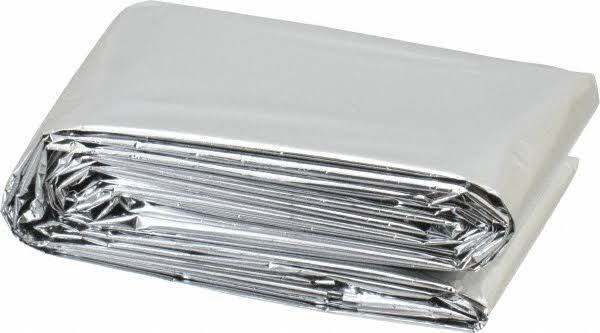
 What is Space Blanket?

space blanket


 Thermal insulation is based on the use of substances with very low thermal conductivity. But sometimes the most effective way to protect persons or devices from leakage or gain of heat is to use a thermal radiation insulator. 

 Thermal radiation does not require any medium for energy transfer. Moreover, energy transfer by radiation is fastest (at the speed of light) and it suffers no attenuation in a vacuum.

 In contrast to heat transfer by conduction or convection, which take place in the direction of decreasing temperature, thermal radiation heat transfer can occur between two bodies separated by a medium colder than both bodies. 

 For example, solar radiation reaches the surface of the earth after passing through cold layers of atmosphere at high altitudes.

 In order to insulate thermal radiation, space blankets (depending on the function, also known as a Mylar blanket, emergency thermal blanket or safety blanket) can be used. Space blankets were first developed by NASA in 1964.

 The highly reflective insulators are often included in emergency kits (therefore emergency thermal blankets) and are also used by long-distance runners after finishing a race to avoid a large swing in body temperature. Space blankets are designed to reflect heat back to body or deflect heat when used as a shelter from the sun, they can be used to insulate everything from the Mars rovers to marathon runners, from satellites to sun shields, and from rockets to residences.

 It is one of the simplest, yet most versatile spinoffs to come out of the Agency. Highly reflective foils in radiant barriers and reflective insulation systems reflect radiant heat away from persons and living spaces, making them particularly useful in very cold climates.

Comments

Popular posts from this blog

How do Ants sense Food?

  S ugar has a slight odor, particularly granulated beet sugar. While all species of ants can differentiate between a wide variety of odors, the smelling range differs from a few centimeters to meters. Desert ants can smell sugar from up to 3 meters. the food sources that ants cannot smell from a distance they 'smell' it (contact chemoreception) by touching it. So in a way, all the food they detect, they detect it by smelling. So yes, ants smell (although contact chemoreception is more like taste) the sugar. The ant colonies send scout ants to search for food in various directions, often up to a range of 100 to 200 meters.(Depends on the territorial boundary and time of the year). The scout marches steadily in less circuitous paths initially if it has memories of previous feeder locations. (Ants use visual landmarks, and a stereo-smell system to create an odor map and navigate) Periodically it will halt and look for olfactory cues. It will then take into a more circuitous rando...

What is the smallest possible Distance in The Universe?

In physics, the Planck length, denoted ℓP, is a unit of length that is the distance light travels in one unit of Planck time. It is also the reduced Compton wavelength of a particle with Planck mass. It is equal to 5.72938×10⁻³⁵ m (Lorentz–Heaviside version) or 1.61623×10⁻³⁵ m (Gaussian version). It is a base unit in the system of Planck units, developed by physicist Max Planck. The Planck length can be defined from three fundamental physical constants: the speed of light in a vacuum, the Planck constant, and the gravitational constant. It is the smallest distance about which current, experimentally corroborated, models of physics can make meaningful statements. At such small distances, the conventional laws of macro-physics no longer apply, and even relativistic physics requires special treatment. The smallest possible size for anything in the universe is the Planck Length, which is 1.6 x10 -35 m across. It is impossible to determine the difference between two locations less than one ...

What is The International Space Station?

  The International Space Station is a large spacecraft. It orbits around Earth. It is a home where astronauts live. The space station is also a science lab. Many countries worked together to build it. They also work together to use it. The space station is made of many pieces. The pieces were put together in space by astronauts.  The ISS consists of pressurized modules, external trusses, solar arrays and other components. ISS components have been launched by Russian Proton and Soyuzrockets as well as American Space Shuttles. The space station's orbit is about 220 miles above Earth. NASA and other space agencies uses the station to learn about living and working in space. The first piece of the International Space Station was launched in 1998. A Russian rocket launched that piece. After that, more pieces were added. Two years later, the station was ready for people. The first crew arrived in October 2000. People have lived on the space station ever since. Over time more pieces...