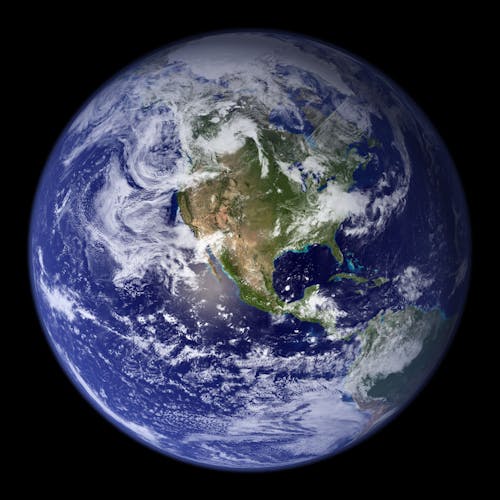
Earth's shine seems to be fading due to global warming as the oceans heat up


Earth's shine

In recent years, the climate change crisis has escalated to unprecedented levels, resulting in unimaginable and life-changing consequences. An acclaimed new study contends that global warming is dimming our planet, literally!

Global warming is causing the Earth's brightness to decrease, according to a new study. Now you're probably wondering, "how do you even measure something like that?" But researchers have their ways. Keeping track of the Earth's shine requires them to calculate the Earth's 'albedo', or reflectance. The albedo is calculated utilizing something called the 'earthshine'.


The crescent moon is most noticeable immediately after sunset or before sunrise, when its dazzling crescent gives way to a dark disc with a faint glow. A crescent moon's unlit parts are known as earthshine because they are glowing from the light reflected from the Earth.

The study revealed that earthshine data over the last three years indicates that our home planet is reflected almost half a watt less light than it did 20 years ago. This is equivalent to a 0.5% reduction in Earth's reflectance.

Earth's shine

Between 1998 and 2017, researchers studied earthshine at the Big Bear Solar Observatory in California to determine the Earth's 'albedo.' Over 1,500 nights of data were collected. This analysis allowed them to calculate the amount of light reflected by the planet.


Comments

  1. The dance between curiosity and discovery never fails to leave me in awe—it's a reminder that even in the familiar, there are hidden depths waiting to be explored. What a beautifully woven perspective that invites us to look closer and think deeper. 🌙 darkmarket link

    ReplyDelete

Post a Comment

Popular posts from this blog

How do Ants sense Food?

  S ugar has a slight odor, particularly granulated beet sugar. While all species of ants can differentiate between a wide variety of odors, the smelling range differs from a few centimeters to meters. Desert ants can smell sugar from up to 3 meters. the food sources that ants cannot smell from a distance they 'smell' it (contact chemoreception) by touching it. So in a way, all the food they detect, they detect it by smelling. So yes, ants smell (although contact chemoreception is more like taste) the sugar. The ant colonies send scout ants to search for food in various directions, often up to a range of 100 to 200 meters.(Depends on the territorial boundary and time of the year). The scout marches steadily in less circuitous paths initially if it has memories of previous feeder locations. (Ants use visual landmarks, and a stereo-smell system to create an odor map and navigate) Periodically it will halt and look for olfactory cues. It will then take into a more circuitous rando...

What is the smallest possible Distance in The Universe?

In physics, the Planck length, denoted â„“P, is a unit of length that is the distance light travels in one unit of Planck time. It is also the reduced Compton wavelength of a particle with Planck mass. It is equal to 5.72938×10⁻³⁵ m (Lorentz–Heaviside version) or 1.61623×10⁻³⁵ m (Gaussian version). It is a base unit in the system of Planck units, developed by physicist Max Planck. The Planck length can be defined from three fundamental physical constants: the speed of light in a vacuum, the Planck constant, and the gravitational constant. It is the smallest distance about which current, experimentally corroborated, models of physics can make meaningful statements. At such small distances, the conventional laws of macro-physics no longer apply, and even relativistic physics requires special treatment. The smallest possible size for anything in the universe is the Planck Length, which is 1.6 x10 -35 m across. It is impossible to determine the difference between two locations less than one ...

What is The International Space Station?

  The International Space Station is a large spacecraft. It orbits around Earth. It is a home where astronauts live. The space station is also a science lab. Many countries worked together to build it. They also work together to use it. The space station is made of many pieces. The pieces were put together in space by astronauts.  The ISS consists of pressurized modules, external trusses, solar arrays and other components. ISS components have been launched by Russian Proton and Soyuzrockets as well as American Space Shuttles. The space station's orbit is about 220 miles above Earth. NASA and other space agencies uses the station to learn about living and working in space. The first piece of the International Space Station was launched in 1998. A Russian rocket launched that piece. After that, more pieces were added. Two years later, the station was ready for people. The first crew arrived in October 2000. People have lived on the space station ever since. Over time more pieces...